http://www.sciencedaily.com/releases/2010/08/100831121437.htm
ScienceDaily (Sep. 1, 2010) — Girls are hitting puberty earlier and earlier. One recent study found that more than 10 percent of American girls have some breast development by age 7. This news has upset many people, but it may make evolutionary sense in some cases for girls to develop faster, according to the authors of a new paper published in Psychological Science, a journal of the Association for Psychological Science.
Girls who physically mature earlier tend to start dating, have sexual intercourse at a younger age, and have more sexual partners than girls who develop later. That puts them at risk of sexually transmitted diseases and makes them more likely to have a child while they're still teenagers. These are generally seen as bad things, says Jay Belsky, of Birkbeck University in London, given that many psychologists and doctors think there are right and wrong ways to develop. But he says it makes more sense to look at development the way nature does -- from an evolutionary perspective. This leads to the expectation that growing up in a risky, unstable environment -- the kind that fosters an insecure rather than secure attachment of infant to mother -- should accelerate pubertal maturation thus increasing the chances that one could reproduce before they die.
----- (skipping)
Results revealed, as predicted, that girls who were insecure as babies started their pubertal development sooner -- by about two to four months -- than girls who were secure as babies. They also completed pubertal development sooner and had their first period earlier than girls who were secure as infants.
A risky, unstable early environment, as reflected in an insecure attachment, is not the only reason girls mature early; it's also partly due to genetics. Environmental chemicals may also have some effect. Also, there's been a trend over the last 150 years of girls maturing earlier, possibly because of improved nutrition. But the early rearing environment and the infant-mother attachment relationship are important influences and should not be ignored, says Belsky. He cowrote the study with Renate Houts of Duke University and Pasco Fearon of the University of Reading.
"An evolutionary biology perspective says, 'look, the thing that nature most cares about -- with respect to all living things, humans included -- is dispersing genes in future generations,'" says Belsky. "Thus, under those conditions in which the future appears precarious, where I might not even survive long enough to breed tomorrow, then I should mature earlier so I can mate earlier before that precarious future might get me." This is the evolutionary logic, according to Belsky, which led to the prediction -- and now evidence -- that early insecurity should be related to earlier pubertal development.
..
Saturday, September 04, 2010


Link Between Everyday Stress and Obesity Strenthened With Study Using an Animal Model
http://www.sciencedaily.com/releases/2010/09/100901145250.htm
ScienceDaily (Sep. 1, 2010) — Stress can take a daily toll on us that has broad physical and psychological implications. Science has long documented the effect of extreme stress, such as war, injury or traumatic grief on humans. Typically, such situations cause victims to decrease their food intake and body weight. Recent studies, however, tend to suggest that social stress--public speaking, tests, job and relationship pressures--may have the opposite effect--over-eating and weight gain. With the rise of obesity rates, science has increasingly focused on its causes and effects--including stress.
A recent study conducted by the Departments of Psychiatry and Biomedical Engineering at the University of Cincinnati College of Medicine, examined the effects of stress on the meal patterns and food intake of animals exposed to the equivalent of everyday stress on humans. The results suggest that, not only does stress have an impact on us in the short term, it can cause metabolic changes in the longer term that contribute to obesity.
----- (skipping)
..
Friday, September 03, 2010
Ex-workers at egg farms say safety complaints were ignored
I wonder if this is one of the agencies where Republicans are blocking President Obama's appointments. Even once he appoints a head of an agency, it takes time to effect change. After 8 years of Bush, we can expect that some government agencies do not have an orientation to service to the public. But according to Libertarians, we don't need government regulation, because business will do the right thing. Silly.
http://www.msnbc.msn.com/id/38987945/ns/health-food_safety/
By MICHAEL J. CRUMB
updated 9/3/2010 9:37:51 AM ET
DES MOINES, Iowa — U.S. Agriculture Department employees working full-time at two Iowa egg farms at the center of a salmonella outbreak and massive recall ignored complaints about conditions at one site, two former employees say.
The ex-workers at Wright County Egg facilities, Robert and Deanna Arnold, said they reported problems such as leaking manure and dead chickens to USDA employees, but nothing was done.
The USDA employees were based next to areas where roughly 7.7 million caged hens laid eggs at the two operations, but agency spokesman Caleb Weaver said their main duties were "grading" the eggs and they weren't primarily responsible for looking for health problems.
In response to the outbreak that has led to a recall of about 550 million eggs, the U.S. Food and Drug Administration examined the Wright County Egg and Hillandale Farms and noted in a report this week that inspectors found rodents, wild birds, seeping manure and maggots in the operations there.
Weaver said the USDA employee who oversaw grading at the facility did not recall anyone raising issues.
'They didn't care'
The USDA "graders" worked in buildings adjacent to where hens laid eggs, focusing on weighing, measuring and inspecting eggs before they were packaged. They are the people who determine if an egg is A or AA, for instance.
"It didn't matter which USDA officer was working, if we reported something they would just turn their heads," Deanna Arnold said. "They didn't care."
----- (skipping)
..
Too Much Aluminum in Infant Formulas
http://www.sciencedaily.com/releases/2010/09/100901111444.htm
ScienceDaily (Sep. 2, 2010) — The aluminum content of a range of the most popular brands of infant formulas remains high, and particularly so for a product designed for preterm infants and a soya-based product designed for infants with cow's milk intolerances and allergies, researchers have found.
A study by a team at Keele University in Staffordshire, led by Dr Chris Exley with Shelle-Ann M Burrell, demonstrating the vulnerability of infants to early exposure to aluminum serves to highlight an urgent need to reduce the aluminum content of infant formulas to as-low-a-level as is practically possible. The research has been published in the journal BMC Pediatrics.
Infant formulas are integral to the nutritional requirements of preterm and term infants. While it has been known for decades that infant formulas are contaminated with significant amounts of aluminum there is little evidence that manufacturers consider this to be a health issue. Aluminum is non-essential and is linked to human disease. There is evidence of both immediate and delayed toxicity in infants, and especially preterm infants, exposed to aluminum and the team contends that there is still too much aluminum in infant formulas.
There has been a long and significant history documenting the contamination of infant formulas by aluminum and consequent health effects in children. Through these and other publications manufacturers of infant formulas have been made fully aware of the potentially compounded issue of both the contamination by aluminum and the heightened vulnerability, from the point of view of a newborn's developing physiology, of infants fed such formulas.
There have been similar warnings over several decades in relation to aluminum toxicity and parenteral nutrition of preterm and term infants. To these ends the expectation would be that the aluminum content of current infant formulas would at the very least be historically low and at best would be as low as might be achieved for a processed product. The team tested this premise and found that the aluminum content of a range of branded infant formulas remains too high.
----- (skipping)
..
ScienceDaily: Your source for the latest research news and science breakthroughs -- updated daily Science News Share Blog Cite Print Email Bookmark 'Charitable' Behavior Found in Bacteria
http://www.sciencedaily.com/releases/2010/09/100901132157.htm
ScienceDaily (Sep. 1, 2010) — Researchers at Boston University and the Wyss Institute for Biologically Inspired Engineering at Harvard have discovered that charitable behavior exists in one of the most microscopic forms of life -- bacteria. Their findings appear in the Sept. 2 issue of Nature.
In studying the development of antibiotic-resistant strains of bacteria, the researchers found that the populations most adept at withstanding doses of antibiotics are those in which a few highly resistant isolates sacrifice their own well being to improve the group's overall chance of survival.
This bacterial altruism results when the most resistant isolates produce a small molecule called indole.
Indole acts as something of a steroid, helping the strain's more vulnerable members bulk up enough to fight off the antibiotic onslaught. But while indole may save the group, its production takes a toll on the fitness level of the individual isolates that produce it.
"We weren't expecting to find this," said lead investigator James J. Collins, Ph.D., professor of Biomedical Engineering at Boston University and a core faculty member of the Wyss Institute. "Typically, you would expect only the resistant strains to survive, with the susceptible ones dying off in the face of antibiotic stress. We were quite surprised to find the weak strains not only surviving, but thriving."
----- (skipping)
..
Children Who Eat Vended Snack Foods Face Chronic Health Problems, Poor Diet
http://www.sciencedaily.com/releases/2010/09/100902173444.htm
ScienceDaily (Sep. 2, 2010) — School children who consume foods purchased in vending machines are more likely to develop poor diet quality -- and that may be associated with being overweight, obese or at risk for chronic health problems such as diabetes and coronary artery disease, according to research from the University of Michigan Medical School.
The study also looked at foods sold in school stores, snack bars and other related sales that compete with USDA lunch program offerings and found that these pose the same health and diet risks in school-aged children.
"The foods that children are exposed to early on in life influence the pattern for their eating habits as adults," says lead study author Madhuri Kakarala, M.D., Ph.D., clinical lecturer of internal medicine at the U-M Medical School.
----- (skipping)
..
Thursday, September 02, 2010
Humanlike brain structures identified in marine worm
I guess a worm would say that wormlike brain structures have been found in humans!
http://www.msnbc.msn.com/id/38974889/ns/technology_and_science-science/
By Jennifer Viegas
updated 9/2/2010 12:52:05 PM ET
* Share
* Font:
* +
* -
Brain structures directly related to the human brain have just been identified in a marine ragworm, according to a paper published in the latest issue of the journal Cell.
The discovery means that the origins of the human brain can now be traced back at least 600 million years, when we last shared a common ancestor with this species, Platynereis dumerilii, a relative of the common earthworm.
"This worm lives in self-made tubes, explores its environment actively for food, and shows signs of learning behavior," lead author Raju Tomer told Discovery News. "Therefore, we thought this ragworm would be the ideal candidate to look for the counterparts of vertebrate higher brain centers in invertebrates."
----- (skipping)
..
Wednesday, September 01, 2010
Record ocean temperatures off the U.S. Mid-Atlantic Coast
Scientists predicted earlier this year that we would have a busier than average hurricane season in the Atlantic, partly because of the high SSTs (Sea Surface Temperatures). And we are currently in what would be normally be a cooling phase, because of solar cycles. In fact, scientists worried that this temporary cooling cycle would allow people to ignore global warming. Of course, when the cycle returns to normal, we can expect even more extreme weather.
There was much boo-hooing about language scientists used to describe GW deniers. I haven't seen specifics, but I'm sure it wasn't anywhere near as bad as I would use. I consider the heads of Exxon/Mobile, and the Koch brothers, who are funding global warming denial campaigns, for the sake of their own financial interests in the oil industry, to be evil sociopathic mass-murdering slimy scum.
http://www.wunderground.com/blog/JeffMasters/comment.html?entrynum=1598
----- (skipping)
Record ocean temperatures off the U.S. Mid-Atlantic Coast
The period May - July was the hottest such 3-month period in history for the Northeast and Southeast U.S., according to NOAA's National Climatic Data Center. Most of the hurricane-prone states along the coast, including New Hampshire, Massachusetts, Rhode Island, New Jersey, Delaware, Maryland, Virginia, North Carolina, and South Carolina had their hottest May - July in the 116-year record. These record air temperatures led to record ocean temperatures, according to an analysis I did of monthly average 5x5 degree SST data available from the UK Met Office Hadley Centre.. The region of ocean bounded by 35N - 40N, 75W - 70W, which goes from Cape Hatteras, North Carolina to Central New Jersey, had the warmest July ocean temperatures since records began in 1875--a remarkable 2.12°C (3.8°F) above average. The year 2008 was a distant second place, with temperatures 1.5°C (2.7°F) above average. The ocean region off the Southeast U.S. coast, bounded by 30N - 35N, 80W - 75W, from the Georgia-Florida border to Cape Hatteras, North Carolina, had its 4th warmest July ocean temperatures on record. Temperatures were 0.8°C (1.4°F) above average, which fell short of the record 1.1°C anomaly of 1944. The August numbers are not available yet, but will probably show a similar story.
----- (skipping)
..
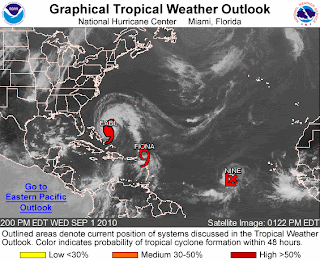
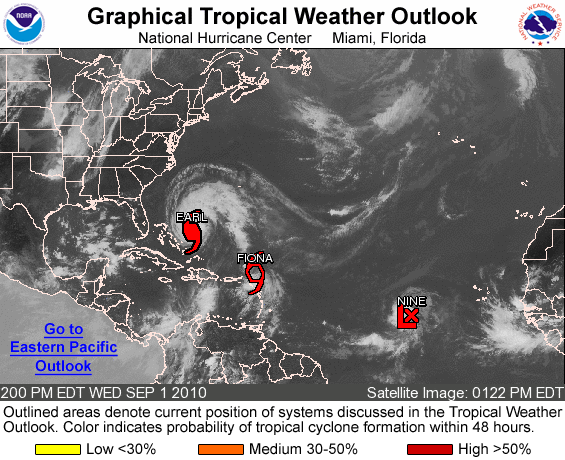
Hurricane season in full force.
There's hurricane Earl heading for N. Carolina, New England, and Canada.
Behind it is tropical storm Fiona.
Behind that is tropical depression 9.
Behind that is a weather system coming off Africa. Now that it is moving over the ocean, it has gotten noticeably bigger than yesterday.
----- (skipping)
..
Behind it is tropical storm Fiona.
Behind that is tropical depression 9.
Behind that is a weather system coming off Africa. Now that it is moving over the ocean, it has gotten noticeably bigger than yesterday.
----- (skipping)
..
Monday, August 30, 2010
I will return :)
I'll be posting again in a day or two. Pretty busy right now, getting my song demo up, car battery died, real busy at work.
----- (skipping)
..
----- (skipping)
..
Friday, August 27, 2010
The Oneness of Being
http://www.myspace.com/patriciashannonsongs
I finally got a demo of my favorite song I've written, thanks to the help of David Leonard of Reveal Audio studio
.
I have it posted at Myspace.
David's web page is at
http://www.revealaudio.com/
..
I finally got a demo of my favorite song I've written, thanks to the help of David Leonard of Reveal Audio studio
.
I have it posted at Myspace.
David's web page is at
http://www.revealaudio.com/
..
The Northwest and Northeast Passages are open
http://www.wunderground.com/blog/JeffMasters/comment.html?entrynum=1589
----- (skipping)
The Northwest Passage--the legendary shipping route through ice-choked Canadian waters at the top of the world--melted free of ice last week, and is now open for navigation, according to satellite mosaics available from the National Snow and Ice Data Center and The University of Illinois Cryosphere Today. This summer marks the fourth consecutive year--and fourth time in recorded history--that the fabled passage has opened for navigation. Over the past four days, warm temperatures and southerly winds over Siberia have also led to intermittent opening of the Northeast Passage, the shipping route along the north coast of Russia through the Arctic Ocean. It is now possible to completely circumnavigate the Arctic Ocean in ice-free waters, and this will probably be the case for at least a month. This year marks the third consecutive year--and the third time in recorded history--that both the Northwest Passage and Northeast Passage have melted free, according to the National Snow and Ice Data Center. The Northeast Passage opened for the first time in recorded history in 2005, and the Northwest Passage in 2007. It now appears that the opening of one or both of these northern passages is the new norm, and business interests are taking note--commercial shipping in the Arctic is on the increase, and there is increasing interest in oil drilling. The great polar explorers of past centuries would be astounded at how the Arctic has changed in the 21st century.
----- (skipping)
..
----- (skipping)
The Northwest Passage--the legendary shipping route through ice-choked Canadian waters at the top of the world--melted free of ice last week, and is now open for navigation, according to satellite mosaics available from the National Snow and Ice Data Center and The University of Illinois Cryosphere Today. This summer marks the fourth consecutive year--and fourth time in recorded history--that the fabled passage has opened for navigation. Over the past four days, warm temperatures and southerly winds over Siberia have also led to intermittent opening of the Northeast Passage, the shipping route along the north coast of Russia through the Arctic Ocean. It is now possible to completely circumnavigate the Arctic Ocean in ice-free waters, and this will probably be the case for at least a month. This year marks the third consecutive year--and the third time in recorded history--that both the Northwest Passage and Northeast Passage have melted free, according to the National Snow and Ice Data Center. The Northeast Passage opened for the first time in recorded history in 2005, and the Northwest Passage in 2007. It now appears that the opening of one or both of these northern passages is the new norm, and business interests are taking note--commercial shipping in the Arctic is on the increase, and there is increasing interest in oil drilling. The great polar explorers of past centuries would be astounded at how the Arctic has changed in the 21st century.
----- (skipping)
..
Tofu Ingredient Yields Formaldehyde-Free Glue for Plywood and Other Wood Products
http://www.sciencedaily.com/releases/2010/08/100825131455.htm
ScienceDaily (Aug. 26, 2010) — In a real-life "back to the future" story, scientists have reported that the sustainable, environmentally-friendly process that gave birth to plywood a century ago is re-emerging as a "green" alternative to wood adhesives made from petroleum. Speaking at the 240th National Meeting of the American Chemical Society, they described development of new soy-based glues that use a substance in soy milk and tofu and could mean a new generation of more eco-friendly furniture, cabinets, flooring, and other wood products.
The new adhesive contains soy flour and an additive used to make paper towels resist water. It performs as well as conventional wood adhesives for interior products, the scientists said, and does not produce the harmful formaldehyde vapors released from traditional plywood, particleboard, and other composite products.
----- (skipping)
Certain petroleum-based adhesives can release formaldehyde, a potential human carcinogen, or substance capable of causing cancer. Formaldehyde fumes from these materials also can cause short-term symptoms, especially in sensitive people. These include watery eyes; burning sensations in the eyes, nose, and throat; and skin irritation. Such problems, combined with high petroleum prices and concerns about sustainability, are spurring wood manufacturers to take another look at soy, Frihart said.
----- (skipping)
..
Moisture Farming
I'm sure this will remind a lot of people of Luke Skywalkers foster family on Tatooine.
http://www.sciencedaily.com/releases/2010/08/100825154757.htm
ScienceDaily (Aug. 26, 2010) — Some rural Moroccans have to trek for miles every day because their arid environment doesn't provide enough drinking water. Or does it?
Six Rice students with the James A. Baker III Institute for Public Policy's Energy Forum spent a month helping with a project that harvests potable water from the fog that envelops parts of the Atlas Mountains. The students were joined by Amy Myers Jaffe, a fellow in energy studies at the Baker Institute and associate director of the Rice Energy Program; Ronald Soligo, professor of economics; and Eugenia Georges, professor and chair of anthropology. They worked with the Dar Si Hmad Foundation in Sidi Ifni, Morocco, to move forward an engineering program to capture tiny droplets of water with a polyethylene mesh in the mountainous Boutmezguida region of southern Morocco.
The volleyball-net-like structures grab liquid from the fog, which drips down the nets into collecting tubes. Gravity propels the drops down pipes that terminate at a water storage tank at the bottom of the mountain. The sustainable project could theoretically provide clean, safe water for people in the area.
----- (skipping)
While he acknowledged that the nets cannot supply enough water for a metropolitan area, Liu said they can make a real difference for rural families. At a cost of roughly $1,000-$1,500 to cover materials and maintenance for an average 10-year lifespan, he said, "we can provide anywhere from 200 to 1,000 liters of water per day for a village." They also looked into the possibility of harvesting water that accumulated on trees by spreading tarps on the ground beneath them. The idea stemmed from observing indicators of water accumulation on the vegetation. Ideally, the vegetation acts as a natural fog collector.
----- (skipping)
Liu echoed Jaffe's conclusion: "Although we may think we know what is best for other countries, it is impossible for us to put ourselves in their shoes. That is why a comprehensive survey needs to be done before any construction so we can get a feel of the situation. If you just go and build without understanding the culture and the relationships of the locals (and what is socially acceptable), you could do more harm than good."
..
A Moment on the Lips, a Year on the Hips
http://www.sciencedaily.com/releases/2010/08/100824191602.htm
ScienceDaily (Aug. 23, 2010) — A short period of excess food consumption can have long term effects on your body weight and fat storage even after the initial weight is lost. A study published in BioMed Central's open access journal Nutrition & Metabolism has found that a four-week episode of increased energy intake and decreased exercise can cause increased weight and fat mass more than two years later when compared to control individuals.
Åsa Ernersson worked with a team of researchers from Linköping University Sweden to investigate the long term effects of a sedentary and gluttonous lifestyle. They capped the physical activity of 18 individuals and used excessive food consumption to increase their energy intake by an average of 70% for four weeks. A separate control group ate and exercised as normal.
The intervention group gained an average of 6.4 kg in body weight, which was mostly lost 6 months later. However, one year later the intervention group showed an increased fat mass compared to baseline; the differences were even greater after two and a half years. Ernersson said "The long term difference in body weight in the intervention and control groups suggests that there is an extended effect on fat mass after a short period of large food consumption and minimal exercise."
The study provides interesting new evidence to suggest that even a short period of excessive eating and a lack of exercise can potentially change an individual's physiology, causing it to be harder to lose and keep off weight. Ernersson summarised, "The change of fat mass was larger than expected when compared to the controls, it suggests that even short-term behavioural changes may have prolonged effects on health."
----- (skipping)
..
Thursday, August 26, 2010
Electricity Collected from the Air Could Become the Newest Alternative Energy Source
http://www.sciencedaily.com/releases/2010/08/100825185121.htm
ScienceDaily (Aug. 26, 2010) — Imagine devices that capture electricity from the air ― much like solar cells capture sunlight ― and using them to light a house or recharge an electric car. Imagine using similar panels on the rooftops of buildings to prevent lightning before it forms. Strange as it may sound, scientists already are in the early stages of developing such devices, according to a report presented at the 240th National Meeting of the American Chemical Society (ACS).
----- (skipping)
Scientists once believed that water droplets in the atmosphere were electrically neutral, and remained so even after coming into contact with the electrical charges on dust particles and droplets of other liquids. But new evidence suggested that water in the atmosphere really does pick up an electrical charge.
Galembeck and colleagues confirmed that idea, using laboratory experiments that simulated water's contact with dust particles in the air. They used tiny particles of silica and aluminum phosphate, both common airborne substances, showing that silica became more negatively charged in the presence of high humidity and aluminum phosphate became more positively charged. High humidity means high levels of water vapor in the air ― the vapor that condenses and becomes visible as "fog" on windows of air-conditioned cars and buildings on steamy summer days.
"This was clear evidence that water in the atmosphere can accumulate electrical charges and transfer them to other materials it comes into contact with," Galembeck explained. "We are calling this 'hygroelectricity,' meaning 'humidity electricity'."
In the future, he added, it may be possible to develop collectors, similar to the solar cells that collect the sunlight to produce electricity, to capture hygroelectricity and route it to homes and businesses. Just as solar cells work best in sunny areas of the world, hygroelectrical panels would work more efficiently in areas with high humidity, such as the northeastern and southeastern United States and the humid tropics.
Galembeck said that a similar approach might help prevent lightning from forming and striking. He envisioned placing hygroelectrical panels on top of buildings in regions that experience frequent thunderstorms. The panels would drain electricity out of the air, and prevent the building of electrical charge that is released in lightning. His research group already is testing metals to identify those with the greatest potential for use in capturing atmospheric electricity and preventing lightning strikes.
..
Study Suggests Link Between Diet Sodas, Preterm Delivery
I don't doubt that artificial sweeteners might be bad for us, but one factor causing these results could be that women with diabetes and/or are overweight might be more likely to drink diet soda, and to have premature babies. Maybe there will be a report in a science blog that tells whether this possibility was allowed for.
http://news.yahoo.com/s/hsn/20100824/hl_hsn/studysuggestslinkbetweendietsodaspretermdelivery;_ylt=AnO3TB_Mwdrvmm6XwRMca5is0NUE;_ylu=X3oDMTNlcWhucTV0BGFzc2V0A2hzbi8yMDEwMDgyNC9zdHVkeXN1Z2dlc3RzbGlua2JldHdlZW5kaWV0c29kYXNwcmV0ZXJtZGVsaXZlcnkEcG9zAzgEc2VjA3luX21vc3RfcG9wdWxhcgRzbGsDc3R1ZHlzdWdnZXN0
By Kathleen Doheny
HealthDay Reporter by Kathleen Doheny
healthday Reporter – 2 hrs 49 mins ago
TUESDAY, Aug. 24 (HealthDay News) -- Could drinking one or more artificially sweetened, carbonated diet sodas a day boost a woman's odds of premature delivery? A new study from Denmark suggests such a link.
The researchers looked at the soft drink habits of nearly 60,000 Danish women enrolled in a national study there from 1996 to 2002.
The investigators found a link between the intake of diet carbonated drinks and, to a lesser extent, diet noncarbonated drinks and delivering a baby early.
The study is published online and in the September print issue of the American Journal of Clinical Nutrition.
In the report, the researchers conclude: "Daily intake of artificially sweetened soft drinks may increase the risk of preterm delivery."
The researchers defined preterm as delivering before 37 weeks' gestation. They categorized the women into groups depending on beverage drinking habits: those who never drank soft drinks or those who drank less than one per week, one to six per week, one each day, two or three per day, or four or more daily.
In all, 4.6 percent of the women delivered early, and one-third of those deliveries were medically induced.
The team found no association between the premature delivery and the intake of carbonated drinks sweetened with sugar.
However, compared with those who never drank the beverages, women who downed four or more diet (artificially sweetened) carbonated drinks a day were 78 percent more likely to deliver early than women who never drank the beverages. And those who had four or more diet, noncarbonated drinks daily were 29 percent more likely to deliver early.
Those who had one or more carbonated diet drinks a day were 38 percent more likely to deliver early.
Why the diet drinks, especially, were linked with early delivery is not known, but the researchers speculate that the link may be driven by high blood pressure disorders in pregnancy. They note that other studies have found a link between soft drinks and high blood pressure in non-pregnant women.
----- (skipping)
..
Wednesday, August 25, 2010
Drink Water to Curb Weight Gain
http://www.sciencedaily.com/releases/2010/08/100823142929.htm
ScienceDaily (Aug. 23, 2010) — Has the long-sought magic potion in society's "battle with the bulge" finally arrived? An appetite-control agent that requires no prescription, has no common side effects, and costs almost nothing? Scientists report results of a new clinical trial confirming that just two 8-ounce glasses of the stuff, taken before meals, enables people to shed pounds. The weight-loss elixir, they told the 240th National Meeting of the American Chemical Society (ACS), is ordinary water.
"We are presenting results of the first randomized controlled intervention trial demonstrating that increased water consumption is an effective weight loss strategy," said Brenda Davy, Ph.D., senior author on the study. "We found in earlier studies that middle aged and older people who drank two cups of water right before eating a meal ate between 75 and 90 fewer calories during that meal. In this recent study, we found that over the course of 12 weeks, dieters who drank water before meals, three times per day, lost about 5 pounds more than dieters who did not increase their water intake."
"People should drink more water and less sugary, high-calorie drinks. It's a simple way to facilitate weight management."
----- (skipping)
..
Organizations Learn More from Failure Than Success
http://www.sciencedaily.com/releases/2010/08/100823162322.htm
ScienceDaily (Aug. 24, 2010) — While success is surely sweeter than failure, it seems failure is a far better teacher, and organizations that fail spectacularly often flourish more in the long run, according to a new study by Vinit Desai, assistant professor of management at the University of Colorado Denver Business School.
Desai's research, published in the Academy of Management Journal, focused on companies and organizations that launch satellites, rockets and shuttles into space -- an arena where failures are high profile and hard to conceal.
Working with Peter Madsen, assistant professor at BYU School of Management, Desai found that organizations not only learned more from failure than success, they retained that knowledge longer.
"We found that the knowledge gained from success was often fleeting while knowledge from failure stuck around for years," he said. "But there is a tendency in organizations to ignore failure or try not to focus on it. Managers may fire people or turn over the entire workforce while they should be treating the failure as a learning opportunity."
The researchers said they discovered little "significant organizational learning from success" but added "we do not discount the possibility that it may occur in other settings."
Desai compared the flights of the space shuttle Atlantis and the Challenger. During the 2002 Atlantis flight, a piece of insulation broke off and damaged the left solid rocket booster but did not impede the mission or the program. There was little follow-up or investigation.
The Challenger was launched next and another piece of insulation broke off. This time the shuttle and its seven-person crew were destroyed.
The disaster prompted the suspension of shuttle flights and led to a major investigation resulting in 29 recommended changes to prevent future calamities.
The difference in response in the two cases, Desai said, came down to this: The Atlantis was considered a success and the Challenger a failure.
"Whenever you have a failure it causes a company to search for solutions and when you search for solutions it puts you as an executive in a different mindset, a more open mindset," said Desai.
----- (skipping)
"The most significant implication of this study…is that organizational leaders should neither ignore failures nor stigmatize those involved with them," he concluded in the June edition of the Academy of Management Journal, "rather leaders should treat failures as invaluable learning opportunities, encouraging the open sharing of information about them."
..
Child Abuse Declines Nationally in U.S. in Spite of Economic Deterioration
This might be at least part of the reason violent crime rates have been going down. Almost all violent criminals were abused as children. Another factor might be the declining rate of lead pollution. People who are exposed to lead before birth and in early childhood are more likely to have violent behavior. Plus, they would behave more violently toward their own children, making it a double whammy.
http://www.sciencedaily.com/releases/2010/08/100824082331.htm
ScienceDaily (Aug. 24, 2010) — Child abuse declined nationally in the United States in 2008 compared to 2007, according to a new report by the Crimes against Children Research Center at the University of New Hampshire. Sexual abuse declined 6 percent, physical abuse 3 percent and neglect 2 percent.
The report also found that child maltreatment fatalities stayed stable from 2007 to 2008. These trends are noteworthy, according to the report's authors, because 2008 marked the first full year of the current recession, and economic downturns are generally thought to be associated with increased family stress and child maltreatment.
"This is good news, but we need to be very cautious," said lead author David Finkelhor, director of the center and professor of sociology. "It could be that discouragement and despair in families about their deteriorating economic situation take longer than a year to show their effects."
On the other hand, the report notes, the recent declines represent a continuation of a large downward trend for physical and sexual abuse that is now over 15 years in length.
"The long-improvement for sexual and physical abuse may be related to a generation-long effort to educate and respond more effectively and aggressively to the problem," Finkelhor said. "If successful prevention efforts are behind the declines, then the improvements may persist even in the face of social stressors like the recession."
----- (skipping)
..
Subscribe to:
Posts (Atom)