Sunday, May 20, 2012

What percent of US budget goes to foreign aid?


http://masbury.wordpress.com/2008/09/29/what-percent-of-us-budget-goes-to-foreign-aid/

We Americans guess, on average, that 24% of our federal budget goes to development assistance. The real number? Less than one per cent.

Despite laudable recent increases in US giving to reduce poverty, US aid as a percent of personal income is second to last among wealthy nations.

We give about 25 cents per American per day [correction:] year in foreign aid; with private giving, another dime. It’s a lot, in total, because there are a lot of us. But it’s far behind the level of sacrifice made by people in most developed nations.

Further, according to the Borgen Project:

Less than half of aid from the United States goes to the poorest countries
The largest recipients are strategic allies such as Egypt, Israel, Russia, Pakistan, Afghanistan and Iraq.
Israel is the richest country to receive U.S. assistance ($77 per Israeli compared to $3 per person in poor countries).

But look what can be done:

The U.S. was the largest single donor in a global campaign that eradicated smallpox from the world by 1977.
The U.S. provided funding for a program to prevent river blindness in West Africa. As a result of these efforts, 18 million children now living in the program’s region are free from the risk of river blindness.

..

Saturday, May 19, 2012

Equal Rights Spurred Productivity

http://economistsview.typepad.com/economistsview/2012/05/equal-rights-spurred-productivity.html

Friday, May 18, 2012

Chrystia Freeland highlights research showing that reduced discrimination over the last 50 years gave the economy a substantial boost -- increased fairness gave us increased efficiency. Unfortunately, however, it appears that new barriers may be emerging:

Equal rights and the U.S. economy, by Chrystia Freeland: Are equal rights good for the economy? ... A draft paper by four U.S. economists makes the strong empirical case... Fairness, they contend, has made the economy more productive. Chang-Tai Hsieh, Erik Hurst, Charles Jones and Peter Klenow argue that as much as 20 percent of the growth in productivity in the United States over the past 50 years can be attributed to expanded opportunities for women and blacks. ...

Few women or blacks would describe the United States today as a perfectly color- or gender-neutral economy. But ... female and black workers have felt the change directly in their paychecks. According to the paper, the reduction in frictions since 1960 increased real wages for white women 39 percent; those of black women, who suffered double discrimination and therefore got a double boost, 57 percent; and those of black men 44 percent.

But while the economy as a whole benefited, there was one group that lost out. The paper calculates that the “reduced friction” for women and blacks meant that the real wages of white men were 4.3 percent lower than they would have been without the increased competition. That result explains a political reality that we often don’t like to admit: Gains for women and blacks have come at a price for white men, and that is surely why some of them still resist the rights revolution. ...

Hurst made sure I understood that this final point was just a hypothesis. The economists plan to run it through their model over the next few months and report on their results later this year. But if their theory pans out, their work will tell a story about America over the past 50 years that many of us intuitively will feel to be true – a country that discriminates less and less on the basis of gender, race and now sexual orientation, but where the class divide is becoming so stark as to constitute a new form of discrimination.

Increased inequality and the associated decrease in mobility are usually presented as as issues of fairness, but when barriers prevent people from realizing their potential that has implications for efficiency as well. It hurts both individuals and the economy as a whole when some groups of people face "external barriers."

Tropical storm and hurricane season coming up

Looks like it's time to start keeping an eye on the tropical storm/hurricane web sites.


National Hurricane Center

Tropical Weather & Hurricanes maps

http://www.wunderground.com/blog/JeffMasters/article.html?entrynum=2096

Disturbance 93L off South Carolina coast could become a tropical storm

By Dr. Jeff Masters
Published: 5:11 PM GMT on May 19, 2012

A hybrid low pressure system with both tropical and extratropical characteristics has formed in the waters off the coast of South Carolina, about 120 miles southeast of Myrtle Beach--a little going-away present for outgoing NHC director Bill Read, who retires on June 1! Residents along the South Carolina and North Carolina coast should pay attention to 93L, as it has the potential to strengthen into a tropical storm and hit the coast on Sunday or Monday, with North Carolina at highest risk. NHC designated this system Invest 93L Saturday morning. Wind shear is a moderate 20 knots over 93L, and the storm is over the warm waters of Gulf Stream, which are 81°F (27°C), just above the 26°C threshold usually needed for a tropical storm to form. The system is tangled up with an upper level trough of low pressure, which is pumping cold, dry air into the storm, inhibiting development. Wind shear is expected to remain in the moderate range, 15 - 20 knots, through Monday, which is low enough that 93L has a decent chance of developing into the Atlantic's first tropical depression. Since 93L is very small, it is highly vulnerable to even a modest increase in wind shear or dry air, which could rapidly disrupt it. Conversely, the storm's small size and favorable positioning over the warm waters of the Gulf Stream mean it is also capable of suddenly organizing, and it would not be surprise to see 93L become Tropical Storm Alberto by Sunday. NHC is giving 92L a 50% chance of developing into a tropical depression or tropical storm by Monday. Since 93L is so small, the computer models are having trouble resolving it, and we don't have very good forecasts of the storm right now. Steering currents are weak, and I expect 93L will wander off the coast of South Carolina through Sunday, before getting caught up by a trough of low pressure on Monday which should lift it out to the northeast. Heavy rain showers from 93L are located about 50 miles offshore of the coast of South Carolina, as seen on Wilmington radar. These showers will probably move onshore between Charleston and Wilmington Saturday night and Sunday, bringing 1 - 3 inches of rain to portions of the coast.

With Eye On Future, Billionaire Investor Bets On Paul

So a libertarian funded PayPal and Facebook. Well, that explains their high quality, concern for their users, integrity. [sarcasm]

http://www.npr.org/2012/05/19/153002892/with-eye-on-future-billionaire-investor-bets-on-paul?sc=fb&cc=fp

by Richard Gonzales May 19, 2012

In the race for the Republican presidential nomination, only one candidate remains to challenge presumptive nominee Mitt Romney: Texas Rep. Ron Paul.

Even Paul has said he will no longer campaign in states that have yet to hold their primaries. And Paul has always been considered a long shot to win. But that hasn't deterred many of his hard-core supporters, including the Silicon Valley billionaire who has bankrolled the superPAC backing Paul.

Peter Thiel is a venture capitalist, entrepreneur and co-founder of PayPal. He hit the jackpot again when he gave Mark Zuckerberg the money to launch Facebook.

Thiel's half-million dollar Facebook investment is now worth more than $1 billion. His success and his smarts have made him a virtual rock star in Silicon Valley.

.....

[My comments: A period of very fast innovation is inevitably going to be followed by a slower period. When there are new advances in scientific knowledge, it can lead to a period where this new knowledge leads to new technology. It can't go on forever at this pace. When the easier, more obvious applications have been explored, progress will slow down. New scientific advances on a predictable, convenient timetable. Also, business cannot continually invest in new technology before making a profit from existing investments; they would run out of money.

And sometimes "progress" needs to be reined in. We have continually rushed into technological innovation, only to discover that there are unexpected consequences that are harming us. Environmentalists and others are reacting to this fact. What would be the good of having some new technology if the making of them gives us all cancer, or destroys our food supply, etc. Thiel is an example of the fact that you don't have to be really intelligent in a broad sense in order to be good at making money.]


"Whether we look at transportation, energy, commodity production, food production, agro-tech, nanotechnology — that with the exception of computers, we've had tremendous slowdown," he says.

Thiel acknowledges that computers are getting faster, cheaper and better. But he says that's the virtual world of bits and bytes. In the real world of stuff, Thiel insists, there's been a slowdown.

"I believe we are in a world where innovation in stuff was outlawed. It was basically outlawed in the last 40 years — part of it was environmentalism, part of it was risk aversion," he says. "And all the engineering disciplines that had to do with stuff have basically been outlawed one by one."

In other words, he says government regulation stifles innovation and, without innovation, there is no economic growth.

How to attract hummingbirds to your yard

Nice, I already have tulip poplars in my yard. I'm glad they provide food for hummiingbirds. They are so tall, and the flowers are mostly so high up I haven't seen any hummingbirds that might be feeding on them. Sad thing is that one of the trees was struck by lightning a couple of years ago. But it fell between my home and the one next door, so at least my home was not damaged when it fell.

http://www.mnn.com/your-home/organic-farming-gardening/stories/how-to-attract-hummingbirds-to-your-yard

By Tom Oder Thu, May 10 2012 at 2:22 PM EST

A hummingbird habitat consists of flowers, shrubs and trees that produce nectar and, ideally, a mist-type water feature. Nectar is a liquid rich in sugar that attracts various pollinators, such as bees, moths and hummingbirds. A hummingbird habitat is different from a garden because a habitat provides a place for the tiny birds to feed, hide from predators, nest and raise their young, according to Bill Hilton Jr.

.....

How do I know if a plant produces nectar?
One way is to observe the plants already in your yard to see what birds or insects are visiting them, Hilton said. You can also check with local extension services or nurseries or research plants online.

Are some plants especially attractive to hummingbirds?
Yes. Based on decades of research and observation, Hilton has compiled a list of what he considers 10 of the ruby-throated hummingbird’s favorite native flowers, shrubs and vines that grow in its North American breeding range.

Here’s Hilton’s list, ranked in order of preference:

Trumpet creeper, Campsis radicans
Beebalm or Oswego tea, Monarda didyma
Trumpet honeysuckle, Lonicera sempervirens
Cardinal flower, Lobelia cardinalis
Spotted jewelweed, Impatiens capensis
Red columbine, Aquilegia canadense
Canada lily, Lilium canadense
Indian pink, Spigelia marilandica
Red buckeye, Aesculus pavia
Mountain rosebay or Catawba rhododendron, Rhododendron catawbiense


One of the reasons these plants made his list rather than others is because many of them grow in almost all of the states where the ruby-throat breeds, Hilton says. He cited trumpet creeper as an example.

Other native plants that provide flowers for hummingbirds may already be growing in your yard, including tulip poplars (Liriodendron tulipifera) and sourwood (Oxydendrum arboreum), he added.

Hilton has also compiled a top 10 list of exotics plants, not all of which are cold-hardy, that attract hummingbirds.

.....

Hummingbirds are a gardener’s friend, Hilton said, because they feed on insects such as gnats, mosquitoes and aphids, which provide fats and protein. Sometimes they glean the insects from bark or foliage and other times they will dart to and from a perch to feast on a cloud of gnats.

Can I still hang out a hummingbird feeder?
Of course. The time to do that is roughly from St. Patrick’s Day to Halloween, Hilton said.

He describes the ruby-throat as a cold-weather wimp. Using Atlanta as a yardstick for the East Coast, he says the birds usually will not show up in the South’s largest metro region until St. Patrick’s Day and will generally have left for their winter home in Central America by the end of October. Hummingbird enthusiasts south of Atlanta can plan on the birds showing up a little earlier than St. Patrick’s Day and those further up the East Coast can add a week or more depending on their location.

.....

Progressive Radio Stations

http://www.leftwingradiostations.com

It's easy to find right-wing radio stations.

Friday, May 18, 2012

Rash Limburger says covering pre-existing conditions is 'welfare'

http://www.examiner.com/article/rush-limbaugh-says-covering-pre-existing-conditions-is-welfare

Robert Sobel May 18, 2012

Over the last few months, Rush Limbaugh has had a rough time. After calling Georgetown student, Sandra Fluke, a "slut" and having dozens of sponsors drop him, Limbaugh has been somewhat quiet. During his radio show this week, Limbaugh went off on his thoughts about "Obamacare," including the most popular provisions.

.....

While the law has been hotly debated by liberals and conservatives, not many have argued about the two most popular provisions. Children being able to stay under the parent's health insurance until they are 26 years old and the demand that insurance companies no longer deny people for pre-existing conditions are popular among Americans across the country, even in conservative circles. While many support those two parts of the Affordable Health Care Act, not everyone does.

.....

Media Matters provides the audio of the text below.

"Look, I live in ‘Realville‘, I'm the Mayor. You force insurance companies to cover pre existing conditions and were not talking insurance anymore, where talking welfare. It's not insurance."

Thursday, May 17, 2012

Stocks Return More With Democrat in White House: BGOV Barometer

http://www.bloomberg.com/news/2012-02-22/stocks-return-more-with-dem-in-white-house-bgov-barometer.html

By Bob Drummond - Feb 22, 2012 12:00 AM ET

While Republicans promote themselves as the friendliest party for Wall Street, stock investors do better when Democrats occupy the White House. From a dollars- and-cents standpoint, it’s not even close.

The BGOV Barometer shows that, over the five decades since John F. Kennedy was inaugurated, $1,000 invested in a hypothetical fund that tracks the Standard & Poor’s 500 Index (SPX) only when Democrats are in the White House would have been worth $10,920 at the close of trading yesterday.

That’s more than nine times the dollar return an investor would have realized from following a similar strategy during Republican administrations. A $1,000 stake invested in a fund that followed the S&P 500 under Republican presidents, starting with Richard Nixon, would have grown to $2,087 on the day George W. Bush left office.

Earth images

http://www.huffingtonpost.com/2012/05/11/high-resolution-earth-photo-electro-l-satellite_n_1510538.html

The amazing zoomable photo and video below [see link], shot by Russian weather satellite Electro-L, are derived from the the highest resolution images ever taken of Earth.

======================================

You can zoom in and out and move the image up, down, right, left.

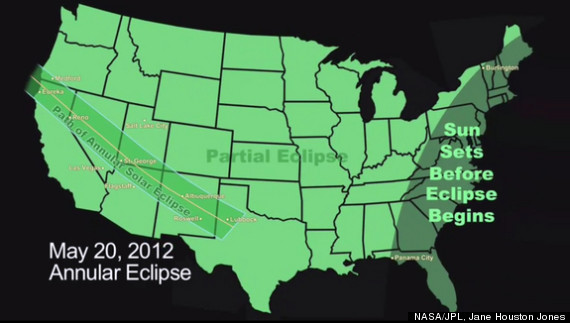
Annular Solar Eclipse May 20

http://eclipse.gsfc.nasa.gov/eclipse.html

Shows info for lunar and solar eclipses.

There will be an annular solar eclipse May 20

http://eclipse.gsfc.nasa.gov/OH/OH2012.html#SE2012May20A


http://www.huffingtonpost.com/2012/05/17/solar-eclipse-2012-where-when-ring-of-fire_n_1524365.html


'Gaydar' Automatic and More Accurate for Women's Faces; Accurate Even When Faces Were Upside Down, Psychologists Find

http://www.sciencedaily.com/releases/2012/05/120516115859.htm

ScienceDaily (May 16, 2012) — After seeing faces for less than a blink of an eye, college students have accuracy greater than mere chance in judging others' sexual orientation. Their "gaydar" persisted even when they saw the photos upside-down, and gay versus straight judgments were more accurate for women's faces than for men's.

.....

Tabak says that our ability to spontaneously assess sexual orientation based on observation or instinct conflicts with the assertion that if people just kept their sexual orientation to themselves then no one else would know and discrimination wouldn't exist, an argument frequently used by opponents of anti-discrimination policies for lesbian, gay and bisexual people.

Wednesday, May 16, 2012

Chronic Child Abuse Strong Indicator of Negative Adult Experiences

http://www.sciencedaily.com/releases/2012/05/120515131321.htm

ScienceDaily (May 15, 2012) — Child abuse or neglect are strong predictors of major health and emotional problems, but little is known about how the chronicity of the maltreatment may increase future harm apart from other risk factors in a child's life.

.....
"For every measure studied, a more chronic history of child maltreatment reports was powerfully predictive of worse outcomes," Jonson-Reid says.

"For most outcomes, having a single maltreatment report put children at a 20 percent to 50 percent higher risk than non-maltreated comparison children.

In addition, a series of adult outcomes were tracked to see if the chronicity of maltreatment still mattered after controlling for the poor outcomes in adolescence. Adult outcomes included adult substance abuse or growing up and having children whom they then maltreated.

"In models of adult outcomes, children with four or more reports were about least twice as likely to later abuse their own children and have contact with the mental health system, even when controlling for the negative outcomes during adolescence." Jonson-Reid says that there appears to be good reason to put resources into preventing ongoing maltreatment.

"Successfully interrupting chronic child maltreatment may well reduce risk of a wide range of other costly child and adolescent health and behavioral problems," she says.

Jonson-Reid cites a recently published Centers for Disease Control and Prevention study estimating lifetime costs for a single year's worth of children reported for maltreatment at $242 billion.

"What our study illustrates is that these costs are even more likely to accrue for children who continue to be re-reported," she says.

The study also found that maltreatment predicts a range of negative adolescent outcomes, and those adolescent outcomes then predict poor adult outcomes.

"If the poor outcomes in adolescence can be dealt with effectively, then later adult outcomes may also be forestalled," Jonson-Reid says.

"Our findings could therefore be interpreted as supporting many current evidence-based interventions that seek to improve behavioral and social functioning among children and adolescents who have experienced trauma like abuse or neglect."

Air Pollution Level Changes in Beijing Linked With Biomarkers of Cardiovascular Disease

http://www.sciencedaily.com/releases/2012/05/120515165407.htm

ScienceDaily (May 15, 2012) — During the 2008 Beijing Olympics, changes in air pollution were associated with changes in biomarkers of systemic inflammation and thrombosis (formation of blood clot) as well as measures of cardiovascular physiology in healthy young persons, according to a study in the May 16 issue of JAMA, a theme issue on Global Health.

New Look at Prolonged Radiation Exposure: At Low Dose-Rate, Radiation Poses Little Risk to DNA, Study Suggests

http://www.sciencedaily.com/releases/2012/05/120515181256.htm

ScienceDaily (May 15, 2012) — A new study from MIT scientists suggests that the guidelines governments use to determine when to evacuate people following a nuclear accident may be too conservative.

The study, led by Bevin Engelward and Jacquelyn Yanch and published in the journal Environmental Health Perspectives, found that when mice were exposed to radiation doses about 400 times greater than background levels for five weeks, no DNA damage could be detected.

Current U.S. regulations require that residents of any area that reaches radiation levels eight times higher than background should be evacuated. However, the financial and emotional cost of such relocation may not be worthwhile, the researchers say.

"There are no data that say that's a dangerous level," says Yanch, a senior lecturer in MIT's Department of Nuclear Science and

Mixed Bacterial Communities Evolve to Share Resources, Not Compete

http://www.sciencedaily.com/releases/2012/05/120515203011.htm

ScienceDaily (May 15, 2012) — New research shows how bacteria evolve to increase ecosystem functioning by recycling each other's waste. The study provides some of the first evidence for how interactions between species shape evolution when there is a diverse community.

Common Fungicide Wreaks Havoc On Freshwater Ecosystems

http://www.sciencedaily.com/releases/2012/05/120516120146.htm

ScienceDaily (May 16, 2012) — Chlorothalonil, one of the world's most common fungicides used pervasively on food crops and golf courses, was lethal to a wide variety of freshwater organisms in a new study, University of South Florida researchers said.

Biologists Taegan McMahon and Jason Rohr, co-authors of the study published in the journal Ecology Letters, report that chlorothalonil killed amphibians, snails, zooplankton, algae, and aquatic plants below estimated environmental concentrations previously deemed safe by the U.S. Environmental Protection Agency. The loss of these herbivores and plants freed the algae from predation and competition, which eventually resulted in algal blooms that were similar to the effects of eutrophication.

"Some species were able to recover from the chemical assault, but the ecosystem was fundamentally changed after its exposure to chlorothalonil," Rohr said.

Ancient Tree-Ring Records from Southwest U.S. Suggest Today's Megafires Are Truly Unusual

I have seen some people blame environmentalism for the suppression of fires, but what would they say if authorities allowed fires to possibly burn down their own homes? They would probably be pretty mad.

http://www.sciencedaily.com/releases/2012/05/120516120304.htm

ScienceDaily (May 16, 2012) — Today's mega forest fires of the southwestern U.S. are truly unusual and exceptional in the long-term record, suggests a new study that examined hundreds of years of ancient tree ring and fire data from two distinct climate periods.

Researchers constructed and analyzed a statistical model that encompassed 1,500 years of climate and fire patterns to test, in part, whether today's dry, hot climate alone is causing the megafires that routinely destroy millions of acres of forest, according to study co-author and fire anthropologist Christopher I. Roos, Southern Methodist University, Dallas.

The researchers found that even when ancient climates varied from each other -- one hotter and drier and the other cooler and wetter -- the frequencies of year-to-year weather patterns that drive fire activity were similar.

The findings suggest that today's megafires, at least in the southwestern U.S., are atypical, according to Roos and co-author Thomas W. Swetnam, the University of Arizona. Furthermore, the findings implicate as the cause not only modern climate change, but also human activity over the last century, the researchers said.

"The U.S. would not be experiencing massive large-canopy-killing crown fires today if human activities had not begun to suppress the low-severity surface fires that were so common more than a century ago," said Roos, an assistant professor in the SMU Department of Anthropology.

Today's extreme droughts caused by climate change probably would not cause megafires if not for a century of livestock grazing and firefighting, which have combined to create more dense forests with accumulated logs and other fuels that now make them more vulnerable than ever to extreme droughts. One answer to today's megafires might be changes in fire management.

"If anything, what climate change reminds us is that it's pretty urgent that we deal with the structural problems in the forests. The forests may be equipped to handle the climate change, but not in the condition that they're currently in. They haven't been in that condition before," Roos said.

Humanmade Pollutants May Be Driving Earth's Tropical Belt Expansion: May Impact Large-Scale Atmospheric Circulation

http://www.sciencedaily.com/releases/2012/05/120516140004.htm

cienceDaily (May 16, 2012) — Black carbon aerosols and tropospheric ozone, both humanmade pollutants emitted predominantly in the Northern Hemisphere's low- to mid-latitudes, are most likely pushing the boundary of the tropics further poleward in that hemisphere, new research by a team of scientists shows.

While stratospheric ozone depletion has already been shown to be the primary driver of the expansion of the tropics in the Southern Hemisphere, the researchers are the first to report that black carbon and tropospheric ozone are the most likely primary drivers of the tropical expansion observed in the Northern Hemisphere.

Head Impacts in Contact Sports May Reduce Learning in College Athletes

http://www.sciencedaily.com/releases/2012/05/120516173721.htm

ScienceDaily (May 16, 2012) — A new study suggests that head impacts experienced during contact sports such as football and hockey may worsen some college athletes' ability to acquire new information. The research is published in the May 16, 2012, online issue of Neurology®, the medical journal of the American Academy of Neurology.

Tuesday, May 15, 2012

The wrong Carlos: how Texas sent an innocent man to his death

http://www.guardian.co.uk/world/2012/may/15/carlos-texas-innocent-man-death

Ed Pilkington in New York
guardian.co.uk, Monday 14 May 2012 23.00 EDT

A few years ago, Antonin Scalia, one of the nine justices on the US supreme court, made a bold statement. There has not been, he said, "a single case – not one – in which it is clear that a person was executed for a crime he did not commit. If such an event had occurred … the innocent's name would be shouted from the rooftops."

Scalia may have to eat his words. It is now clear that a person was executed for a crime he did not commit, and his name – Carlos DeLuna – is being shouted from the rooftops of the Columbia Human Rights Law Review. The august journal has cleared its entire spring edition, doubling its normal size to 436 pages, to carry an extraordinary investigation by a Columbia law school professor and his students.

The book sets out in precise and shocking detail how an innocent man was sent to his death on 8 December 1989, courtesy of the state of Texas. Los Tocayos Carlos: An Anatomy of a Wrongful Execution, is based on six years of intensive detective work by Professor James Liebman and 12 students.

Starting in 2004, they meticulously chased down every possible lead in the case, interviewing more than 100 witnesses, perusing about 900 pieces of source material and poring over crime scene photographs and legal documents that, when stacked, stand over 10ft high.

What they discovered stunned even Liebman, who, as an expert in America's use of capital punishment, was well versed in its flaws. "It was a house of cards. We found that everything that could go wrong did go wrong," he says.

.....

From the moment of his arrest until the day of his death by lethal injection six years later, DeLuna consistently protested he was innocent. He went further – he said that though he hadn't committed the murder, he knew who had. He even named the culprit: a notoriously violent criminal called Carlos Hernandez.

.....

At the trial, DeLuna's defence team told the jury that Carlos Hernandez, not DeLuna, was the murderer. But the prosecutors ridiculed that suggestion. They told the jury that police had looked for a "Carlos Hernandez" after his name had been passed to them by DeLuna's lawyers, without success. They had concluded that Hernandez was a fabrication, a "phantom" who simply did not exist. The chief prosecutor said in summing up that Hernandez was a "figment of DeLuna's imagination".

Four years after DeLuna was executed, Liebman decided to look into the DeLuna case as part of a project he was undertaking into the fallibility of the death penalty. He asked a private investigator to spend one day – just one day – looking for signs of the elusive Carlos Hernandez.

By the end of that single day the investigator had uncovered evidence that had eluded scores of Texan police officers, prosecutors, defense lawyers and judges over the six years between DeLuna's arrest and execution. Carlos Hernandez did indeed exist.

Liebman's investigator tracked down within a few hours a woman who was related to both the Carloses. She supplied Hernandez's date of birth, which in turn allowed the unlocking of Hernandez's criminal past as the case rapidly unravelled.

.....

Many other glaring discrepancies also stand out in the DeLuna case. He was put on death row largely on the eyewitness testimony of one man, Kevan Baker, who had seen the fight inside the Shamrock and watched the attacker flee the scene.

Yet when Baker was interviewed 20 years later, he said that he hadn't been that sure about the identification as he had trouble telling one Hispanic person apart from another.

Then there was the crime-scene investigation. Detectives failed to carry out or bungled basic forensic procedures that might have revealed information about the killer. No blood samples were collected and tested for the culprit's blood type.

Fingerprinting was so badly handled that no useable fingerprints were taken. None of the items found on the floor of the Shamrock – a cigarette stub, chewing gum, a button, comb and beer cans – were forensically examined for saliva or blood.

There was no scraping of the victim's fingernails for traces of the attacker's skin. When Liebman and his students studied digitally enhanced copies of crime scene photographs, they were amazed to find the footprint from a man's shoe imprinted in a pool of Lopez's blood on the floor – yet no effort was made to measure it.

"There it was," says Liebman. "The murderer had left his calling card at the scene, but it was never used."

Even the murder weapon, the knife, was not properly examined, though it was covered in blood and flesh.

Other photographs show Lopez's blood splattered up to three feet high on the walls of the Shamrock counter. Yet when DeLuna's clothes and shoes were tested for traces of blood, not a single microscopic drop was found. The prosecution said it must have been washed away by the rain.

There appeared to have been an unseemly scramble to wrap up the crime scene. Less than two hours after the murder happened, the police chief in charge of the homicide investigation ordered all detectives to quit the Shamrock and allowed its owner to wash it down, sweeping away vital evidence that could have saved a man's life.

The exceptionally lax treatment of evidence continued even beyond the grave. When Liebman asked to see all the stored evidence in the case, so that he could subject it to the DNA testing that was not available to investigators in 1983, he was told that it had all disappeared.

Having lived and breathed this case for so many years, Liebman says the most shocking thing about it was its ordinariness. "This wasn't the trial of OJ Simpson. It was an obscure case, the kind that could involve anybody. Maybe those are the cases where miscarriages of justice happen, the routine everyday cases where nobody thinks enough about the victim, let alone the defendant."

.....

tags: death penalty, miscarriage of justice